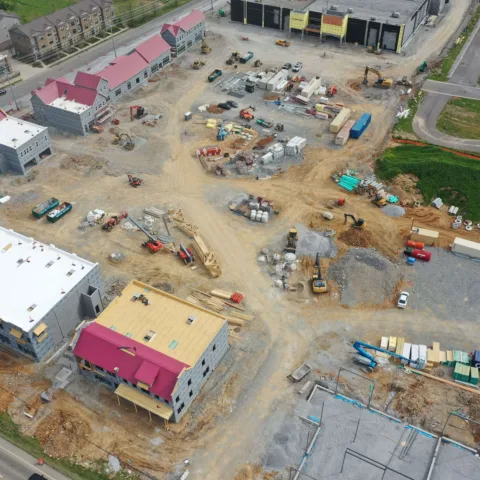
Every year brings its own highs and lows in construction, but 2025 will stand out for our team for a long time. We wrapped up projects we’re proud of—from industrial work like McInerney & Associates’ new flex-space headquarters to mixed-use projects such as Village Green. These projects pushed our team creatively and technically, and each one reminded us why we love this work.
But the year wasn’t without its challenges. Tariffs caught the industry off guard and added pressure to budgets, schedules, and procurement. Interest rates created uncertainty for owners. Several projects across the region hit financial hurdles, delaying construction starts. Through all of it, our team stayed focused. We adjusted procurement strategies, ordered critical materials early, and doubled down on communication with clients and trade partners.
Lessons from 2025: Deeper Dives into Two Award-Winning Projects
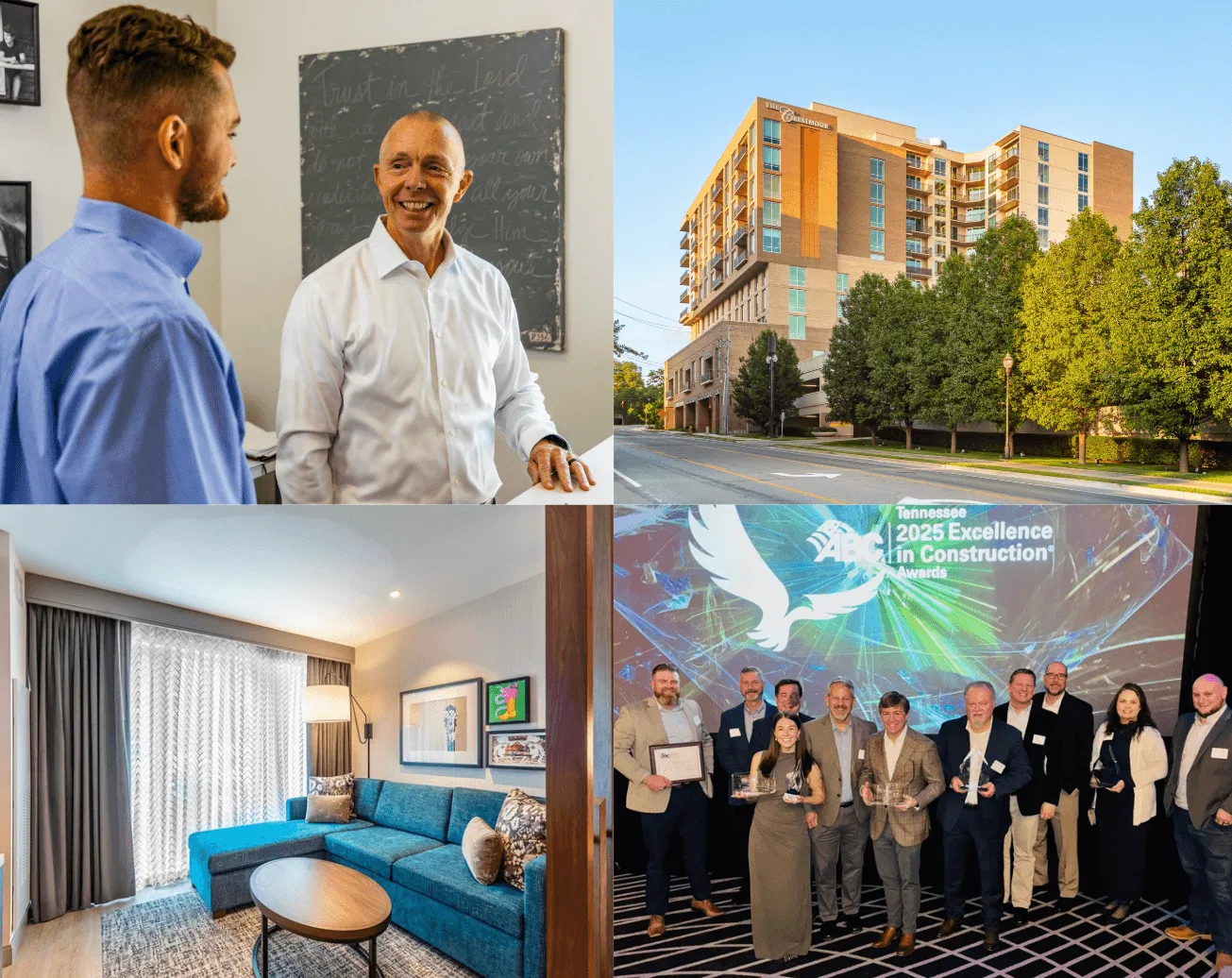
Looking back, we’re grateful—not because it was easy, but because it made us stronger. And when we think about what 2025 taught us, two projects stand out. Both earned ABC Excellence in Construction Awards this year, but more importantly, they gave our team lessons we’ll carry into every job that follows.
1. The Crestmoor Senior Living Facility: Adapting & Persevering When the Stakes are High
The Crestmoor at Green Hills broke ground in 2022 and became one of the most significant projects in our company’s 90-year history. It reached completion in 2025, and our team poured everything we had into the final stretch. This was the kind of project that required patience, consistency, and a deep bench of construction experience.
The scale alone brought challenges, but the real test came in the form of change. Over the course of construction, Crain executed 37 major plan changes. One of the biggest was a mid-project redesign to convert several standard floors into premium penthouse suites. Redesigning that much space while keeping the rest of the project on schedule required steady coordination between owners, architects, engineers, and our field team.
Because Crestmoor is a licensed senior living facility, our work also needed to meet Tennessee Health Facilities Commission (THFC) requirements. That meant meticulous documentation. Our team tracked phased approvals, managed inspections, and worked with engineers in real time to keep the project moving forward. It wasn’t simple, but it paid off. The building met certification standards without slipping off schedule.
Then, toward the end of the project, a major storm knocked out power at the custom brick manufacturer we were working with. Lead times suddenly stretched, and the clock was ticking. Working closely with our masonry subcontractor, we shifted to weekend crews and worked multiple elevations at once to recover lost time. This kind of flexibility only works when you have trusted partners and clear communication on all sides.
We also used Crestmoor as an opportunity to rethink some of our quality-control practices. Several team members introduced new closeout methods and punchlist processes that helped speed up final turnover. Those improvements are now becoming part of our standard playbook.
Crestmoor reminded us that the biggest projects often teach the biggest lessons: stay flexible, stay organized, and keep your communication tight.
2. Tri-Brand Marriott Hotel: Precision in a Live Environment
If Crestmoor tested our ability to adapt, the Tri-Brand Marriott project tested our creativity and coordination. This was a milestone for Nashville. The project involved converting the third floor of an existing parking garage into hotel rooms while the hotel remained fully operational.
There was no traditional workflow to rely on. Every decision had to prioritize hotel guests, valet staff, and the property’s daily rhythm. The team developed a phased schedule and approached the project in a carefully choreographed operation.
Material deliveries had to be timed between check-ins and check-outs, and noise-producing work needed to happen during windows of lower occupancy. Valet operations also added an extra layer of complexity. On a typical day, more than 200 cars passed through areas where our crew was working. Maintaining safe and predictable access required daily coordination with the valet team, strict traffic plans, and a field staff that stayed alert and adaptable at all times.
When issues arose, our team and the hotel staff met quickly to address them. That consistent, transparent communication is what allowed the project to stay on track. The Tri-Brand Marriott demonstrated what can happen when owners, operators, and contractors work as one team. It also highlighted the importance of planning, clear communication, and steady leadership in environments where the margin for error is small.
2025 in Review: Resilience and Takeaways
If we had to sum up 2025 in one word, it would be resilience. Across every project, our team faced challenges, but we met each one with creativity, collaboration, and a commitment to our clients.
That resilience was ultimately reflected in being named ABC’s General Contractor of the Year, an honor we’re deeply grateful for. We see this recognition not as a finish line, but as a testament to the people behind the work. It represents a team that shows up, owns the hard moments, and does what they say they’re going to do.
It also reinforces the value of relationships. With our clients who trusted us through uncertainty. With our trade partners who worked shoulder to shoulder to keep projects moving. And within our own team, where accountability and mutual respect made the difference. These relationships are the foundation of our work, and they’ve been at the heart of Crain for more than 90 years.
As we step into 2026, we’re carrying these lessons forward. We’re excited for what’s ahead and grateful for the partners who continue to trust us to build not just projects, but lasting value for our communities.